
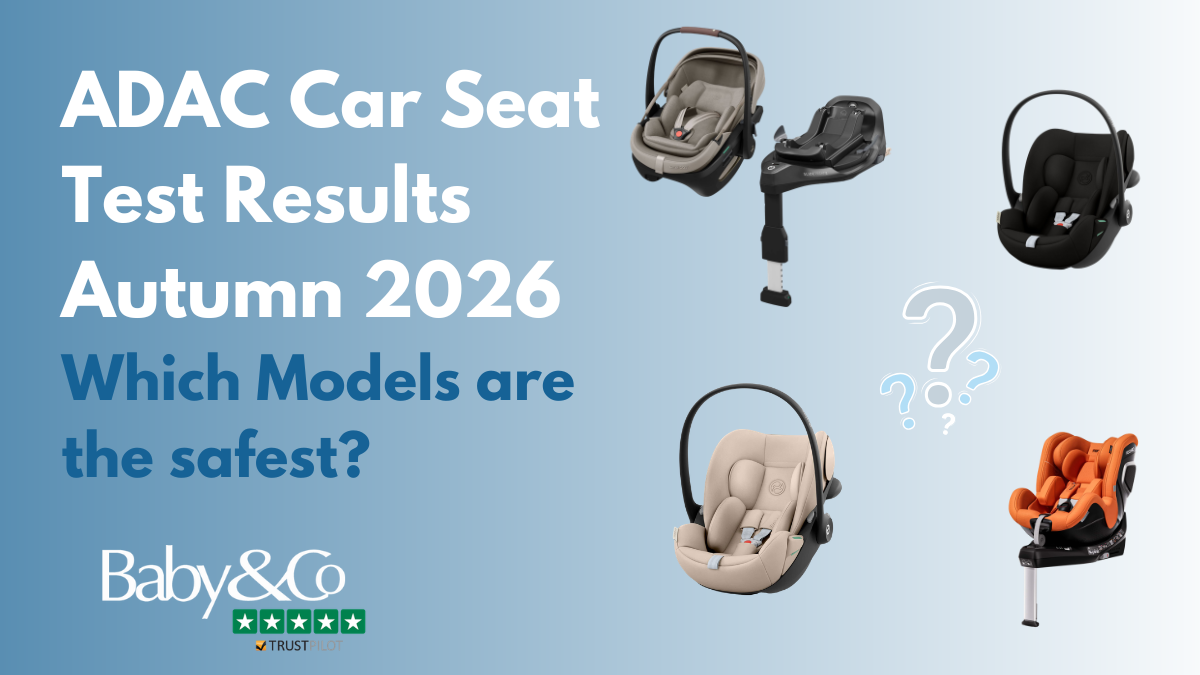
ADAC Car Seat Test Results Autumn 2026
Searching for the ideal car seat to ensure your child's safety? We've summarised the outcomes from ADAC's rigorous test this Autumn to assist you in selecting the perfect car seat.
ADAC Car Seat Test Results Autumn 2026
Looking for the best car seat to keep your little one safe? We've translated the results of this year's rigorous ADAC test to help you decide your perfect car seat.
Shopping for a new car seat? You've come to the right place. We've pulled together the latest findings from ADAC's car seat safety tests so you don't have to go digging yourself.
If the name isn't familiar, ADAC is Europe's largest automobile association — and their testing is a cut above the standard EU requirements. They run two rounds of tests every year, in Spring and Autumn, so their recommendations reflect some of the most up-to-date safety data available.
Their results are published in German, but we've done the legwork for you — translating and summarising everything you need to know, clearly and in plain English.
Which car seats are tested by ADAC?
ADAC does not test every car seat made, but rather they carefully select the seats based on their popularity and those with special features, such as swivel seats, for example. ADAC purchase these seats independently and keep their selection a secret until the release of the results, so you can rely on the results of the tests to be completely unbiased and uninfluenced by any manufacturers. These results are then released to various consumer groups throughout Europe such as Which? to help parents make informed choices in regard to their child’s safety.
How do ADAC test these car seats?
Every car seat sold today has to meet UN Regulation 129 (R129), but ADAC pushes much harder. Its frontal crash tests put far more force on the seat than the legal approval tests do, which is why a seat rated “good” or “satisfactory” can go well beyond the legal minimum.
The 3 main criteria for the tests are:
Safety (50%), Operations (40%), Ergonomics (10%) & Harmful Substances
So, not only is the safety of the seat taken into account, but also the ease of use and fitting, how comfortable the seat is for the child and how accessible the user’s manual is, etc., encouraging manufacturers, in turn, to focus on these aspects for your benefit.
ADAC Car Seat Test — What's Changed in 2025/2026Starting with the spring 2025 test round, ADAC significantly overhauled its testing protocol. The key changes fall into three areas:
1. New Frontal Crash TestThe old method (pre-2025) was conducted at 64 km/h using a VW Polo crashing into a deformable barrier - one that crumples on impact, absorbing energy gradually. That crumple zone meant the deceleration force was spread out over a longer time interval, softening the load on the child seat.
The new method is quite different in every key parameter. A Kia Sportage SUV is accelerated to 50 km/h and hits a rigid (solid, non-deforming) wall after 13 seconds of travel, producing a sudden, very intense impact pulse.The lower speed (50 vs 64 km/h) can seem like it should make things easier, but that's a misconception — in the new setup, there is no crumple zone to absorb energy, so the entire force arrives in a much shorter time interval, and the loading on the child seat is actually higher.
There are two other important dimensions to why the SUV body matters. First, the Kia Sportage is heavier than a VW Polo, so it carries significantly more kinetic energy into the impact. Second, the new test is designed to simulate a realistic scenario — a collision with a fixed obstacle or a heavy vehicle — which is closer to what happens in real-world accidents.
2. New Side Impact TestThe changes here are arguably even more dramatic. In the old side-impact test, a light impactor was used at just 15 km/h. The new test uses a 6-tonne impactor at 60 km/h. That is four times the speed and an enormous increase in mass.The 6-tonne moving barrier simulates a side collision with an SUV or van — exactly the type of accident that occurs frequently in everyday traffic. The increase in both barrier weight and speed reflects the real-world prevalence of large SUVs on European roads and the threat they pose in side collisions.
Why Changes Were Made to the ADAC Test
The new test methodology is grounded in accident research and biomechanics findings. Children are not small adults — they have shorter necks which puts greater stress on the upper cervical spine during movement, and their spine and musculature are still underdeveloped. Research also showed that children aged 12 to 18 months are particularly vulnerable in traffic accidents, which helped drive the revision.Here's a visual summary of the changes:The key insight is the rigid wall change for the frontal test. With the old deformable barrier, the car's crumple zone meant the child seat experienced a gradual deceleration. With a rigid wall, the entire kinetic energy is transferred almost instantaneously — think of the difference between punching a pillow and punching a brick wall at the same speed. The rigid wall produces a much sharper, more violent deceleration pulse even at the lower test speed.For the side impact, the old 15 km/h light barrier was frankly quite modest. The new 6-tonne impactor at 60 km/h simulates precisely the type of accidents that happen frequently in everyday traffic — a large van or SUV T-boning the vehicle at a junction, which is a very common real-world crash scenario.
Why ADAC Results Are No Longer Comparable to Previous Years
Because of these significant changes, results from 2025 onwards can't be directly compared to earlier ADAC tests — the new standard is more demanding than ever. A seat that scored well in 2024 might score lower now not because it got worse, but because the test is harder and closer to real accident conditions.
In short, ADAC has moved from a test that was already among Europe's toughest to one that is now more representative of real-world crashes — bigger vehicles, harder impacts, and broader scrutiny of the materials children are sitting on every day.
What do the ratings mean?
The ratings are grouped into five categories, as pictured. As you can see, the lower the score, the better, so bear this in mind when shopping for your little one’s new car seat.
ADAC scores are a great indicator of the quality of the seat, although as mentioned before, not all seats are tested by ADAC. These tests are extremely scrutinous so if a seat doesn’t have an ADAC score, or if it isn’t within the top ADAC category, this does not mean that the seat is not safe.
ADAC'S Reflection on this Season's Testing
This time, ADAC tested 16 seats for safety, operation, ergonomics, pollutants and environmental pollutants. Seven were rated “good”, five “satisfactory”, two “adequate”, and two failed with “deficient”. The seats covered every age group, from newborn carriers to boosters for bigger children.
ADAC sees the long history of its test as a success story. Manufacturers now design with ADAC’s requirements in mind, and that has steadily raised the quality of seats on the market. Still, this round shows there are real differences between models, and not every seat meets ADAC’s demanding standards.
We’ve compiled a list of some of the car seats from Autumn 2026's ADAC testing for you to peruse, most of which are available at Baby & Co.
Keep scrolling for more information, and to hear what ADAC had to say about some of your favourite seats!
Autumn 2026 Results
Maxi-Cosi Coral Slide Pro & FamilyFix Slide Pro Base
Suitability: Approx. Birth to 1.5 years
Weight: 3.0kg, Base 12.4kg
2.1 - Good
Features:
- Lightweight, removable carrycot
- More upright recline, which gives better protection in a crash
- Modular system, so different seats can attach to one base
- 360° rotation with a 27cm slide
What ADAC had to say:
Security 2.1
ADAC found a low risk of injury in both frontal and side impacts. Belt routing is good, and the seat attaches very securely to the car.
Operation 2.2
There is a low risk of incorrect use. Installation is easy, converting the seat is quick and simple, and the seat is lightweight and well made. The manual and warning labels were slightly weak, and the cover is hand-wash only and hard to remove.
Ergonomics 2.3
Good leg support and padding, a good view outside for the child, and an exemplary seating position with plenty of room. The only downside is that the seat takes up a lot of space in the car.
Additional notes
After testing the materials, ADAC found that there are low pollutant levels and very low PFAS (man-made chemicals).
Maxi-Cosi Coral Slide Pro (Seat only)
Suitability: From Birth -1.5 Years
Seat weight: 8.9kg
3.0 - Satisfactory
Features:
- Lightweight, removable carrycot
- More upright recline, which gives better protection in a crash
- Modular system, so different seats can attach to one base
- 360° rotation with a 27cm slide
What ADAC had to say:
ADAC found an average risk of injury in a frontal crash and said the seat isn’t particularly stable in the car without its base. It keeps the same strengths as the version with the base: it’s lightweight and well made, conversion is quick and simple, and it has good leg support, padding and view out for the child. Installation is more complex without the base, so there is a slightly higher risk of incorrect use. For the best protection, use it with its base (above).
Cybex Cloud G3 & Base G3
Suitability: approx. Birth - 1.5 years
Seat weight: 4.1kg, Base: 6.9kg
2.2 - Good
Features:
- Easy, stable installation
- Adjustable recline for comfort
- Modular system, so different seats can attach to one base
- Approved by certain airlines
What ADAC had to say:
Security 2.2
A low risk of injury in a side impact, optimal belt routing and a very secure attachment to the car. However, ADAC found an average risk of injury in a frontal crash.
Operation 2.0
A low risk of incorrect use, with easy installation and quick, simple conversion. The seat is machine washable and well-made. The manual and warnings are slightly weak, and the cover is somewhat difficult to remove.
Ergonomics 2.6
Good leg support and padding, and an exemplary seating position. On the downside, it takes up a lot of space in the car, and it impairs the child’s view.
Additional notes
The materials used in the seat were found to contain low pollutant levels, with a score of 2.1 for environmental pollutants thanks to very low PFAS.
Cybex Cloud G3 (Seat only)
Suitability: approx. Birth - 1.5 years
Seat weight: 4.1kg
2.3 - Good
Features:
- Easy, stable installation
- Adjustable recline for comfort
- Modular system, so different seats can attach to one base
- Approved by certain airlines
What ADAC had to say:
Without its base, the Cloud G3 still scored “good”. ADAC noted a slightly higher risk of incorrect use, as buckling the child in is a little more difficult. Otherwise, its verdict matches that of the version with the base (above).
Cybex Sirona G3 & Base G3
Suitability: approx. 1 - 4 years
Seat weight: 6.8kg Base: 6.9kg
2.3 - Good
Features:
- Rear-facing travel on an ISOFIX base
- Rotates to the side, making it easier to lift your child in and buckle up
- Can be turned forward-facing from 15 months at the earliest
- Modular system, so different seats can attach to the same base
What ADAC had to say:
Security 2.6
A low risk of injury in a side impact, optimal belt routing and a very secure attachment to the car. However, ADAC found an average risk of injury in a frontal crash.
Operation 2.3
A low risk of incorrect use. Buckling the child in is simple, and converting the seat is very easy and quick. The instructions and warnings are easy to understand, and the seat is lightweight, machine washable and has an easy-to-remove cover and excellent workmanship. Installation is somewhat more complex.
Ergonomics 2.3
Plenty of space for the child. Leg support and seating position aren’t optimal; the padding is thin, the seat takes up extra space in the car, and the child’s view out is impaired.
Additional notes
Slightly elevated pollutant levels, though PFAS content is very low (environmental pollutants score 1.0). Additionally, the Sirona G3 can only be used in i-Size seating positions or cars on Cybex’s approved vehicle list, and it can’t be installed with the car’s seat belt. ADAC tests and scores it together with its base, so there is no separate seat-only result.
Recaro Toron 1
Suitability: From Birth - 4 Years
Seat weight: 12.0kg
2.5 - Good
Features:
- 175° recline
- 360° rotation
- Rear ventilation system
- Adjustable headrest and harness
What ADAC had to say:
Security 2.1
A very low risk of injury in a side impact, good belt routing and a very secure attachment to the car. However, ADAC found an average risk of injury in a frontal crash.
Operation 2.3
A low risk of misuse, with easy installation and quick, simple conversion. The instructions and warnings are easy to understand, and the seat is machine washable with excellent workmanship. The downsides are that buckling the child in is a bit more difficult, the seat is heavy, and the cover is hard to remove.
Ergonomics 2.5
Good padding, a comfortable seating position and plenty of room for the child. Leg support isn’t optimal; the seat takes up extra space in the car, and the child’s view out is impaired.
Additional notes
The materials used in the Recaro Toron 1 were found to contain slightly elevated pollutants, though PFAS content is very low. Additionally, the Toron 1 is fixed to its Isofix base, so you can’t carry a newborn to the car in it. The shell swivels to the side, though, which makes lifting your baby in and buckling up much easier. Children travel rear-facing, which gives good protection in ADAC’s frontal crash test.
Here’s a handy table of the seats we’ve covered from the four most recent ADAC tests, Spring 2025 to Autumn 2026, so you can compare how they performed. All four rounds use ADAC’s updated test, so they can be compared with each other, but please remember the test is much tougher than before 2025, so seats that scored “satisfactory” are still very good.
Why ADAC Results Are No Longer Comparable to Previous Years
And that’s it for our selection of Autumn 2026’s ADAC car seats! Hopefully you’ve seen something to pique your interest. Which car seats have you got your eye on?
More on the Blog
If you can’t find your seat on the list, fear not: all seats rated very good, good and satisfactory since 2015 can still be recommended.
Want to know which seats made it into previous ADAC tests? Check out our previous blog posts:
Do you have some of these products? Let us know how you like them on our socials or leave a review!
Want to stock up for the due date but short on space, managing a budget, or still deciding on your nursery layout? We offer a free Nursery Plan to hold all your baby goods until you’re ready to pay and collect. Find out more on our Nursery Plan page or visit us in store to chat to one of our friendly team.